
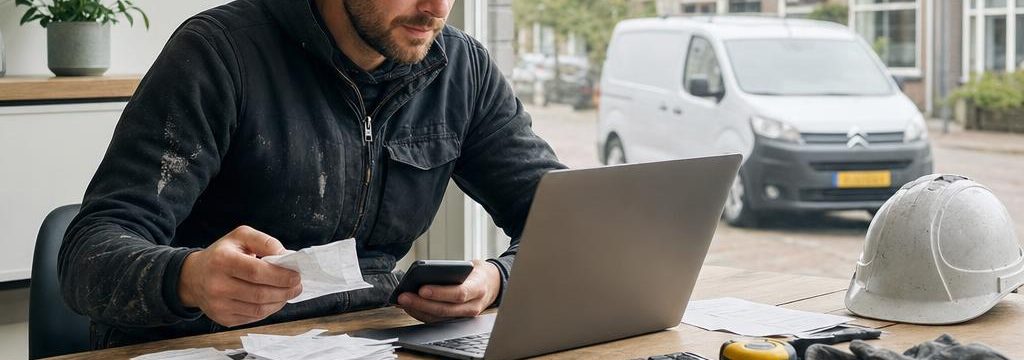
Bookkeeping as a self-employed roofer

As a self-employed roofer, you’d rather focus on quotes, roofs, urgent repairs and ongoing projects—not on loose receipts and unclear figures. Still, solid bookkeeping is essential. You need to keep invoices in order, file VAT returns, track business expenses, and be able to show what you earned and spent. With a smart approach you avoid stress, miss fewer deductions, and keep control of your business. On this page you’ll read what bookkeeping for self-employed roofers entails, what to watch out for, and how to organize it practically and digitally.
Table of contents
- 1Why good bookkeeping matters so much for a self-employed roofer
- 2Which records should you keep as a self-employed roofer?
- 2.1Invoices and quotes
- 2.2Purchase invoices and receipts
- 2.3Bank transactions
- 2.4Time tracking
- 2.5Mileage log
- 3Specific points of attention in a roofer’s bookkeeping
- 4VAT, income tax and deductions for self-employed roofers
- 4.1VAT returns
- 4.2Income tax
- 4.3Common deductible expenses
- 5Car or van in your accounts: what to watch out for?
- 6Do your own bookkeeping or outsource it?
- 7Organize your bookkeeping smarter as a roofer
- 8Common mistakes in self-employed roofers’ bookkeeping
- 9Useful digital tools for bookkeeping as a self-employed roofer
- 10How Profinancials supports self-employed professionals with their bookkeeping
- 11FAQ about bookkeeping as a self-employed roofer
- 11.1What must I keep at a minimum in my records as a self-employed roofer?
- 11.2Can I do my own bookkeeping as a roofer?
- 11.3Which costs are often deductible for a self-employed roofer?
- 11.4Do I have to keep time records as a roofer?
- 11.5Is a digital administration sufficient?
- 11.6What’s smarter: use a private car or a van owned by the business?
- Show more...
Why good bookkeeping matters so much for a self-employed roofer
A roofer’s bookkeeping is more than just keeping receipts. Your accounts form the basis for your VAT return, your income tax return, and your insight into your company’s profit. It’s also a legal requirement to keep proper records.
For roofers this is even more important, because you often deal with fluctuating material costs, transport, tools, safety gear, and different types of jobs. Without an overview you quickly lose track of which invoices are still unpaid, which costs were booked as business expenses, and whether you’ve set aside enough money for taxes.
Good bookkeeping helps you to:
-
send and follow up invoices on time
-
process VAT and business expenses correctly
-
gain insight into your revenue, profit and cash flow
-
make use of tax benefits and deductions
-
avoid mistakes, corrections and fines
Which records should you keep as a self-employed roofer?
As a self-employed roofer you deal with a number of recurring administrative elements. By structuring these well from the start, you make life much easier.
Invoices and quotes
Ideally, every job starts with a clear quote and ends with a correct invoice. Your invoices must include the required details such as your business name, address details, VAT number, Chamber of Commerce (KvK) number, invoice date, invoice number, the date of delivery or prepayment, a clear description of the work, and the amount excluding VAT. If you work with deposits or part payments, you must also record those properly.
Purchase invoices and receipts
Think of expenses for roofing materials, tools, ladders, fall protection, workwear, fuel, parking and phone costs. Keep these receipts and invoices digitally so you can easily find and process them later.
Bank transactions
With a business bank account you keep personal and business separate. That makes your bookkeeping clearer and reduces the risk of errors in your returns.
Time tracking
Time tracking is important if you want to use certain entrepreneur deductions. Record not only your billable hours, but also time for quotes, purchasing, travel to clients, administration, and maintaining your business.
Mileage log
If you use a private car for business trips or want to substantiate business use properly, a complete log is wise. For each trip note the date, starting and ending odometer readings, departure address, arrival address, the purpose of the trip and, if relevant, the route driven.
Specific points of attention in a roofer’s bookkeeping
A roofer’s bookkeeping has some practical features you see less often in other self-employed professions. These make sector-specific attention important.
-
High material usage per job, so purchasing and margin must be closely monitored
-
Frequent travel to projects, suppliers and emergency locations
-
Investments in tools, scaffolding, ladders, trailers or a work van
-
Safety costs such as helmets, harnesses and fall protection
-
Work on site, which means receipts and administration get scattered more easily
-
Seasonal effects causing revenue and planning to fluctuate by period
That’s why a digital administration usually works best in practice. If you can upload a receipt or send an invoice while on the road, you avoid backlogs that cost a lot of time later.
VAT, income tax and deductions for self-employed roofers
Taxes are the trickiest part of bookkeeping for many entrepreneurs. For a self-employed roofer, VAT and income tax are especially important.
VAT returns
You usually remit VAT on your turnover while you can often reclaim VAT on business expenses. That means your records must be up to date. If purchase invoices are missing or processed incorrectly, your return will be wrong. If you file periodically, for example quarterly, it’s smart not to wait until the last moment to submit and check. If you need help with the tax return, arrange it in time.
Income tax
At the end of the year, your business profit is determined. That profit is not the same as the turnover in your bank account. Business expenses, investments and any deductions play a major role.
Common deductible expenses
-
tools and small equipment
-
safety equipment and appropriate workwear
-
phone and internet costs for business use
-
fuel and transport costs
-
accounting software or administrative support
-
costs for a business workspace or storage, if the conditions are met
There may also be entrepreneur schemes or investment allowances. Whether you qualify depends on your situation, your hours and your investments in the financial year. That’s why it’s important that your records are complete and verifiable.
Car or van in your accounts: what to watch out for?
Transport is essential for many roofers. The choice between driving privately or putting a car or van on the business affects your bookkeeping and tax position.
If you use a private car for business trips, a good trip or mileage log is important. If you have a business van or car, you’ll face other points such as vehicle costs in the accounts and possible benefit-in-kind for private use.
What’s smartest in your situation depends on, among other things:
-
how many business kilometers you drive
-
whether you also use the vehicle privately
-
the level of vehicle costs
-
whether you mainly use a work van for materials and tools
Because this has tax consequences, it’s wise not to go by gut feeling but to have it properly assessed in the context of your overall accounts.
Do your own bookkeeping or outsource it?
As a self-employed roofer you can in principle do your own bookkeeping with software. Especially if you have few invoices and your administration is simple, that can work. Still, many independent roofers choose to outsource their administration partly or entirely via an accounting firm for the self-employed.
The main reason is usually time. After a full day on the roof you don’t want to spend hours on receipts, VAT codes and returns. Professional support also reduces the chance that you miss deductions or make mistakes in your accounts.
Doing it yourself often suits you if you:
-
have few transactions
-
work in a well-structured way
-
have sufficient knowledge of VAT and tax rules yourself
Outsourcing is often smarter if you:
-
are growing fast or running many projects at once
-
regularly invest in materials or transport
-
want more insight into figures and taxes
-
want to spend as little time as possible on administration
Organize your bookkeeping smarter as a roofer
Good bookkeeping doesn’t have to be complicated as long as you choose a consistent way of working. For roofers, simplicity usually works best.
-
Use a business bank account exclusively for business.
-
Create quotes and invoices in one system.
-
Upload receipts right after purchase or at the end of the workday.
-
Schedule a fixed weekly moment to check outstanding items and costs.
-
Record your hours and business kilometers immediately, not afterwards.
-
Set aside part of your revenue for VAT and income tax.
If you work digitally, you’ll get faster insight into what still needs to come in and which costs have already been processed. That brings peace of mind and makes your bookkeeping less error-prone.
Common mistakes in self-employed roofers’ bookkeeping
Most problems don’t arise from complex rules but from small things left undone for too long. These mistakes occur often:
-
losing receipts or processing them much later
-
mixing personal and business expenses
-
not keeping proper time records
-
not recording mileage
-
filing VAT returns based on incomplete records
-
booking investments and regular expenses incorrectly
-
invoicing too late or not following up on outstanding invoices
Especially in a practical trade like roofing, it’s tempting to postpone administration. But the longer you wait, the greater the chance of missing information and unnecessary mistakes.
Useful digital tools for bookkeeping as a self-employed roofer
Because you’re often on the road, mobile and digital support is extra handy. A practical setup usually consists of a combination of:
-
accounting software for invoices, expenses and VAT
-
an app for uploading receipts
-
connections with your business bank account
-
time tracking for your business administration
-
optionally a trips log for business mileage
For self-employed bookkeeping, Profinancials works with digital processing and mentions SnelStart as an example of software that can automatically read receipts and invoices. That suits entrepreneurs who want to submit their records easily while keeping up-to-date insight.
How Profinancials supports self-employed professionals with their bookkeeping
Profinancials focuses on self-employed professionals and entrepreneurs who want to arrange their bookkeeping and tax matters clearly. Although there’s no separate service page for roofers on the website, a self-employed roofer does fit within the general self-employed proposition and the broader services for entrepreneurs.
What Profinancials demonstrably offers is an all-in approach to bookkeeping and tax advice. They take care of bookkeeping, VAT returns and the annual report, among other things. The records are kept digitally and you submit your documents easily, for example by uploading receipts. You also get a dedicated advisor for questions and tax considerations.
That’s especially interesting if you as a roofer:
-
want to spend less time on your bookkeeping
-
want more control over VAT and tax deadlines
-
want to be sure your bookkeeping is set up properly
-
are looking for a fixed sparring partner for your self-employed administration
FAQ about bookkeeping as a self-employed roofer
What must I keep at a minimum in my records as a self-employed roofer?
At minimum you must keep your sales invoices, purchase invoices, receipts, bank statements and other business documents. Maintain a mileage log or time tracking if you need it for tax deductions or to substantiate business use. Everything must be verifiable and well organized for your own insight and for the tax authorities.
Can I do my own bookkeeping as a roofer?
Yes, you can if your records are straightforward and you’re willing to learn about VAT, expense processing and returns. If you have little time or want less risk of errors, outsourcing is often more practical. If you want to first discuss your situation, an advice session can be a logical step.
Which costs are often deductible for a self-employed roofer?
Common business expenses include tools, safety equipment, workwear, transport, phone, software and other business costs directly related to your work. Whether something is truly deductible depends on tax rules and how you use it.
Do I have to keep time records as a roofer?
It’s strongly recommended. Time tracking not only gives you an overview but can also be important for entrepreneur schemes and deductions. So record all your business hours, not just hours on the job.
Is a digital administration sufficient?
Yes, as long as your records are complete, readable and well kept. For many roofers, working digitally is even more convenient because you can upload receipts on the go and keep an overview more quickly. Anyone who wants to know how it works can read more about it.
What’s smarter: use a private car or a van owned by the business?
That depends on your use, the number of business kilometers and whether you also drive the vehicle privately. Because this has tax implications, it’s wise to align this choice with your overall bookkeeping and tax situation.
Related articles

Required documents for the annual accounts
Do you want your annual accoun…

Checklist for switching payroll administration
Switching your payroll adminis…

Penalties for late filing
Being late with your tax retur…
